The Art of French Macarons: A Journey from Novice to Aspiring Master Baker
Macarons, distinct from the chewy coconut macaroons, are an exquisite symbol of French pâtisserie, celebrated worldwide for their delicate elegance and sophisticated flavor profiles. These ethereal meringue-based cookies are meticulously crafted from fine almond flour, granulated sugar, and whipped egg whites, resulting in a uniquely crisp shell that yields to a tender, chewy interior. Typically, they are brought to life with a luscious filling, most commonly a rich buttercream frosting, which perfectly complements their subtle sweetness.
The allure of macarons extends beyond their vibrant aesthetics and delightful taste; it encompasses the challenging yet immensely rewarding process of their creation. Achieving the coveted “foot” – the characteristic ruffled edge at the base of each shell – along with a smooth, unblemished dome and a perfectly tender chew, demands not just ingredients but precision, patience, and an understanding of baking science. For countless home bakers, mastering the art of the macaron represents a formidable but deeply satisfying culinary achievement, transforming simple ingredients into edible works of art.
Embarking on a Culinary Adventure: From Inspiration to First Attempts
My own entry into the intricate world of French macarons was less a confident stride and more a tentative step into an entirely new baking frontier. Given my modest decorating skills—I can barely ice a cake smoothly or pipe a convincing buttercream rose—the notion of tackling these notoriously finicky cookies might have seemed audacious. Yet, the macaron had firmly landed on my baking ‘bucket list’ several months prior, after I was utterly captivated by the beauty of some gorgeous Tiffany Blue macarons.
The universe seemed to align perfectly when Lindsay from Love and Olive Oil announced her April Kitchen Challenge would focus on making macarons. This presented an irresistible opportunity, a clear signal to dive in and experience the challenge firsthand rather than deferring it indefinitely. Little did I fully comprehend the depth of this undertaking! I soon discovered that macaron baking is a rich tapestry of methods, techniques, and what often feels like a series of crucial, almost ‘superstitious’ rituals.
Demystifying the Macaron: In-Depth Research and Preparation
My initial immersion into the vast literature surrounding macarons was a truly humbling experience. It quickly became abundantly clear that crafting macarons is not merely difficult but an exacting art form that demands utmost precision and an unwavering commitment to detail. A consistent theme across various resources was the sheer complexity involved. Furthermore, I encountered a fascinating array of different “schools of thought” regarding the optimal approach to a successful batch, each method championed by passionate bakers. This diversity of opinion, coupled with the delicate nature of the cookie, imbued the entire process with an almost ritualistic quality.
Following Lindsay’s excellent suggestion, I began my comprehensive research with Brave Tart, a veritable treasure trove of macaron knowledge. Her insightful blog posts provided an unparalleled foundation, guiding me through every essential aspect, from the critical nuances of handling meringue to the precise execution of macaronage. Understanding the underlying scientific principles behind each step, rather than simply following instructions by rote, proved to be an incredibly empowering and enlightening experience.
One of the most frequently cited requirements in nearly all macaron recipes is the indispensable use of a food scale for exacting measurements. As I didn’t own one at the time and was keen to begin my baking adventure without delay, I specifically sought out a recipe that could be successfully executed without this particular tool. Ultimately, I carefully adapted the ingredient list from Sprinkle Bakes, known for its creative recipes, while strictly adhering to the comprehensive, step-by-step instructions provided by Brave Tart for her acclaimed macarons. Brave Tart’s invaluable mythbuster article was particularly instrumental, equipping me with the knowledge and confidence to anticipate and mitigate common challenges, ensuring I approached this ambitious project as well-prepared as possible.
The Delicate Dance of Macaron Creation: Mastering Key Stages
The journey to producing a flawless macaron shell is a delicate dance involving several meticulously executed stages. Each step is critical, building upon the last to create the cookie’s signature texture and appearance. It all commences with the fundamental building block:
1. Meringue Perfection: Building the Foundation
At the core of every successful macaron lies a perfectly stable and glossy meringue. This is achieved by whipping room-temperature egg whites with granulated sugar—often superfine or caster sugar, which dissolves more readily. A small pinch of cream of tartar is sometimes added to stabilize the meringue and aid in achieving optimal volume. The objective is to whip the mixture until it forms stiff peaks; that is, when the whisk is lifted, the meringue should hold its shape firmly without collapsing or feeling dry and granular. Careful attention is required here, as over-whipping can lead to brittle shells, while under-whipping results in a weak batter incapable of holding its shape or developing the characteristic “feet.”
2. Preparing the Dry Ingredients: The Quest for Smoothness
Concurrently, the dry components—almond flour and confectioners’ sugar (also known as powdered sugar)—are prepared. For shells that boast an impeccably smooth and blemish-free surface, it is paramount that these two ingredients are sifted thoroughly, often two or even three times. This meticulous process ensures the removal of any lingering lumps from the powdered sugar and coarser particles from the almond flour, guaranteeing a fine, even powder that is crucial for the macaron’s delicate texture and refined appearance. Any larger almond bits remaining after sifting should ideally be discarded or briefly pulsed in a food processor with a small amount of sugar before re-sifting.
3. The Art of Macaronage: Folding with Finesse
Perhaps the most critical, and frequently daunting, stage is macaronage—the precise technique of folding the prepared dry ingredients into the meringue. This step demands a delicate balance: the meringue must be deflated just enough to create a batter with a very specific, flowing consistency. The ideal batter should fall off your rubber spatula in a thick, continuous ribbon, slowly melting back into the main mixture within 20-30 seconds. This highly sought-after “ribbon stage” or “lava-like” consistency is the key indicator that the batter is perfectly ready for piping. An under-mixed batter will be too stiff, resulting in lumpy, footless macarons, while an over-mixed batter will be too runny, causing the shells to spread excessively and fail to develop feet.
4. Piping and Resting: Shaping and Crusting for Success
Once the batter has achieved the perfect macaronage consistency, it is carefully transferred into a pastry bag fitted with a round piping tip. The batter is then uniformly piped onto parchment paper or a specialized silicone baking mat, forming consistent 1½-inch circles. Immediately after piping each tray, the baking sheets must receive a firm tap (or two or three) on the counter. This essential action serves to release any air bubbles inadvertently trapped within the batter, which is crucial for preventing cracked shells and encouraging an even rise. Following piping and tapping, the macarons must be left to rest at room temperature, typically for 30 minutes to an hour (or longer in humid conditions), until a dry “skin” or “crust” forms on their surface. This crust is absolutely vital, as it directs the heat during baking, forcing the macaron batter to expand outwards and form the distinctive “feet” at the base.
5. Baking to Perfection: The Oven’s Crucial Role
Finally, the piped and properly crusted macarons are carefully transferred into a preheated oven, usually set to a relatively low temperature, typically around 300°F (150°C). The exact baking time, generally ranging from 10 to 15 minutes, can vary significantly depending on the specific calibration of your oven and the size of your individual macarons. A reliable indicator of doneness is when the macaron shells can be gently lifted cleanly from the parchment paper without sticking or tearing, and their “feet” appear well-defined and stable. Rotating the baking sheets halfway through the baking cycle is often recommended to ensure uniform heat distribution and consistent results. Overbaking can lead to dry, hollow, or overly browned shells, while underbaking results in sticky, soft, and fragile macarons.
My Macaron Marathon: Lessons from the Kitchen
While the detailed explanation of the macaron-making process might suggest a clear path to success, my initial attempts were anything but straightforward. It took three dedicated batches, each offering its own set of challenges, to even begin to grasp the intricate nuances. My very first batch, unfortunately, was a categorical failure. They bore no resemblance to the delicate cookies I envisioned and offered little in the way of edible redemption. It was a truly humbling, yet formative, introduction to the world of macaron baking.
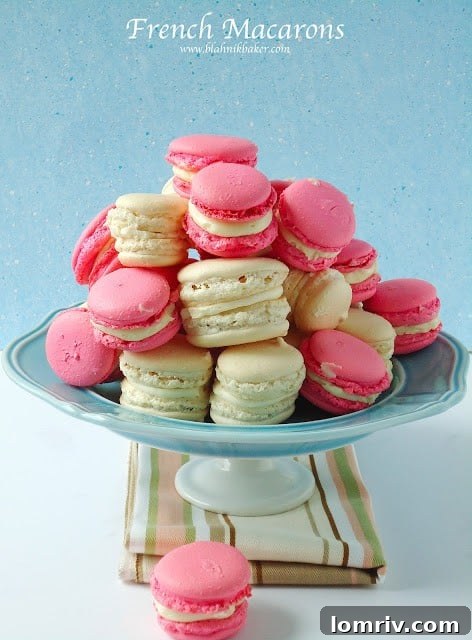
The second batch, distinguished by a lovely cream color, showed tangible signs of improvement. However, perfection remained elusive; instead of perfectly circular, the shells emerged distinctly oval-shaped and baked somewhat crookedly on the tray. While progress was undeniable, the consistency of shape and evenness of baking proved challenging to achieve. It became evident that factors such as inconsistent piping, unresolved air bubbles, or even potential hot spots within my oven were still at play.
My third attempt, which produced charming pink shells, represented a significant breakthrough. This time, the macarons were considerably more circular and aesthetically pleasing, showing a much closer resemblance to the desired form. Yet, the journey was not without its lingering hurdles; some shells still baked slightly crookedly, and frustratingly, a few of the delicate tops detached from their bases. Despite these lingering imperfections, the overall visual appeal and the developing texture were incredibly encouraging. After three intense and instructive sessions, my French macarons were not yet of professional café quality, and I accepted that with grace. I had set realistic expectations, understanding that true mastery rarely happens on the first few tries. This hands-on experience profoundly reinforced the belief that persistent practice, meticulous observation, and the continuous refinement of technique are absolutely paramount for consistent macaron success.
Embracing Imperfection and the Road to Macaron Mastery
This macaron project, with all its inherent learning curves, proved to be an incredibly rewarding and enriching experience. It profoundly highlighted the immense joy and satisfaction that comes from fearlessly diving into a new culinary challenge, even with minimal prior knowledge, and emerging with invaluable insights and newfound skills. The initial frustrations encountered during the first few batches quickly gave way to a powerful sense of accomplishment and a much deeper appreciation for the intricate artistry and scientific precision involved in crafting these exquisite treats. My heartfelt thanks go to Lindsay for inspiring this ambitious endeavor, for daring me to step well beyond my baking comfort zone, and for igniting a passion for macaron making.
I now eagerly anticipate her next kitchen challenge, excited to discover what new culinary techniques and skills I can acquire and master. If you haven’t yet explored her wonderful blog, Love and Olive Oil, I wholeheartedly recommend you do so immediately! It is an amazing and invaluable resource, brimming with creative recipes and inspiring challenges for both aspiring and seasoned bakers alike.
My macaron journey is far from over; in fact, it feels like it has only just begun. I have many more experiments meticulously planned, eager to continue refining my technique, exploring new and exciting flavor combinations, and perfecting my piping skills. And who knows, you might just catch a glimpse of these delightful creations gracing a certain dessert table I’m diligently planning for an upcoming shower. The pursuit of the perfect macaron is an ongoing quest, a continuous cycle of learning, practicing, and savoring each delightful, even if occasionally imperfect, batch!
French Macaron Recipe: Your Guide to Delicate Perfection
Ready to try your hand at crafting these elegant French cookies? This meticulously adapted recipe provides a comprehensive guide to making delicious macarons, from achieving that desirable signature ‘foot’ to expertly crafting a flavorful and complementary filling. While the entire process indeed demands unwavering attention to detail and precise execution, the immense satisfaction of biting into a homemade macaron that you’ve created is truly unparalleled. Follow these detailed steps closely, and remember not to be discouraged if your very first batch isn’t absolutely picture-perfect—it’s a well-known truth that practice, patience, and perseverance truly make perfect in the captivating world of macarons!

French Macarons
Macarons are delicate French cookies, made from egg whites, sugar, and almond flour, typically filled with delicious buttercream frosting. This recipe guides you through making them!
45 minutes
15 minutes
Ingredients
Macaron Shells
- 1 cup confectioners’ sugar
- ¾ cup fine almond flour
- 2 large egg whites, room temperature
- ½ cup extrafine granulated sugar
- 2 teaspoons vanilla extract
- ½ teaspoon salt
- A pinch of cream of tartar
- Gel food coloring (optional)
Filling
- Lemon Swiss meringue buttercream (or your preferred filling)
Instructions
- Line two sheet pans with parchment paper. To guide piping, use a 1½-inch round cookie cutter to draw circles on the parchment paper, then flip the paper (drawing side down) so the pencil marks don’t transfer to the macarons.
- Preheat your oven to 300 degrees Fahrenheit (150 degrees Celsius) and prepare a pastry bag fitted with a round tip (such as Wilton 2A) for piping.
- In a food processor, pulse the almond flour and confectioners’ sugar together briefly to ensure a very fine consistency. Sift the mixture several times into a clean bowl until there is less than 2 tablespoons of coarse almond bits left. If desired, discard the coarse bits or add them back after light pulsing.
- In the bowl of an electric mixer fitted with the whisk attachment, combine the room-temperature egg whites, extrafine sugar, salt, and cream of tartar. Begin whipping on medium speed (setting 4 on a KitchenAid mixer) for 3 minutes. Increase the speed to medium-high (setting 7) and whip for another 3 minutes. Finally, increase to high speed and whip for an additional 3 minutes, or until the meringue starts to thicken.
- Add the vanilla extract and gel food coloring (if using) to the meringue. Continue whipping on high speed for an additional 2 minutes, or until very stiff, glossy peaks form. When the whisk is lifted, the meringue should hold its shape firmly. Carefully remove the whisk attachment.
- Add all the sifted dry ingredients into the meringue. Using a rubber spatula, carefully begin the macaronage process by gently folding the dry ingredients into the meringue. The goal is to deflate the meringue slightly while incorporating the dry mixture fully. Continue folding, scraping the sides of the bowl, until the batter achieves a lava-like consistency, falling off the spatula in a thick, continuous ribbon that slowly reabsorbs into the bowl within 20-30 seconds. Be careful not to overmix.
- Transfer the prepared macaron batter into the pastry bag. Pipe the batter into the pre-traced circles on your baking sheet, holding the bag vertically. After piping each sheet, tap the baking sheet firmly on the counter 2-3 times to release any trapped air bubbles from the batter, which helps prevent cracked shells and promotes the formation of ‘feet’.
- Let the piped macarons sit undisturbed at room temperature for at least 30 minutes (or up to an hour, depending on humidity) to ‘dry’ or form a skin. The surface should feel dry to the touch and not stick to your finger before baking.
- Bake the macarons for 10-15 minutes. To check for doneness, gently wiggle a macaron shell; if it feels stable and doesn’t move on its ‘foot’, it’s likely done. If the shell comes off when you try to pick it up, it needs more baking time. Rotate the baking sheets halfway through for even baking.
- Once baked, cool the macarons completely on the pans before attempting to peel them from the parchment paper. This prevents breakage and allows them to firm up.
- To fill: Pipe a small mound of your chosen buttercream (like Lemon Swiss meringue buttercream) onto the flat side of one macaron shell, then gently sandwich it with another naked half.
- For optimal flavor and texture, store the filled macarons refrigerated for at least 24 hours before serving. This ‘aging’ period allows the flavors to meld and the shells to soften slightly, achieving the perfect chewiness. (It’s a true macaron secret!)
Notes for Macaron Success
ZAINAB’S NOTES:
- I strongly suggest you read up extensively on macarons and their unique baking science before your first attempt. While there are countless flavors and colors to experiment with, it’s highly recommended to begin with a simple vanilla recipe. This allows you to familiarize yourself with the foundational techniques before adding complexity.
- For my next batch, I will absolutely be investing in a reliable kitchen scale. While I managed to get by this time, I can now fully appreciate how precise measurements of ingredients are crucial for minimizing mishaps and achieving consistent, perfect results in macaron baking.
- Humidity can greatly affect macaron drying time and final texture. On humid days, allow extra resting time for the shells to form a proper skin.
- Oven calibration is key! Ovens can vary widely. Consider using an oven thermometer to ensure your oven is at the correct temperature, as even small fluctuations can impact macaron success.
Making this Recipe?
Share it with us on Instagram using #aclassictwist so we can see what you are baking up in your kitchen!